
The 6 Pieces of Gear That Actually Improved My Landscape Photography
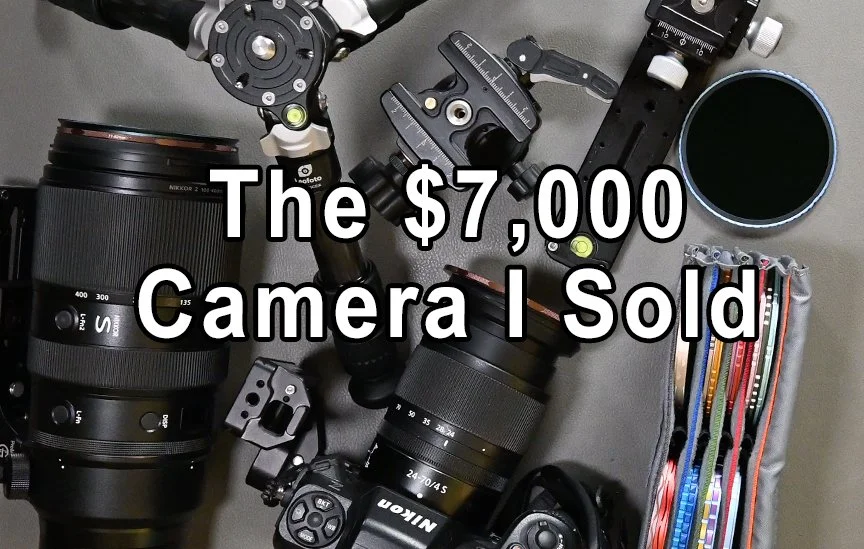
I've owned a lot of photography gear over the years. Different camera systems, lenses, tripods, tripod heads, filters, rails, and more accessories than I probably care to admit. But after more than 30 years of photography, I've come to realize that there is a big difference between owning good equipment and owning equipment that actually changes the way you photograph. That's the idea behind this list. These aren't necessarily the most expensive pieces of equipment I've owned, and they're certainly not a list of the newest products on the market. They're the pieces of gear that solved specific problems for me and, in doing so, gave me more control over the photographs I wanted to make.
One of the easiest traps photographers fall into is asking, "What's the best camera?" or "What's the best tripod?" Those questions sound logical, but they're actually incomplete. The better question is, "What problem am I trying to solve?" That's the question I've learned to ask before spending money on photography equipment. A piece of gear can be beautifully designed, extremely expensive, and highly regarded, yet still be the wrong piece of equipment for the way you photograph. In fact, one of the best examples I can give you is a camera that cost me more than $7,000.
But we'll save that story for later.
The Tripod: Creating a Stable Foundation
The first piece of equipment that has made a real difference in my photography is my tripod system. I've used tripods from companies including Really Right Stuff and ProMediaGear, and my current tripod is the Leofoto LS-284CEX X Ranger with a built-in leveling base. When I'm using a tripod without a built-in leveling base, I use an Acratech Leveling Base.
A tripod doesn't make a photograph better by itself. What it does is create a stable foundation from which I can make deliberate photographic decisions. When I'm photographing a landscape, I don't want to be fighting the camera. I want to put it exactly where I want it, make an adjustment, look at the composition, make another adjustment, and know that the camera will stay where I put it.
That stability is particularly valuable when I'm working slowly, which is often how I approach landscape photography. Once the camera is locked down, I can pay attention to the edges of the frame, watch the light, wait for a cloud to move into the right position, or make a small compositional change without having to start over.
The leveling base adds another important element. Instead of constantly adjusting three tripod legs every time I need to level the camera, I can make that adjustment at the top of the tripod. It's faster, simpler, and particularly useful when I'm making panoramas. If I'm going to rotate the camera through a series of exposures that will eventually be stitched together, having a level and predictable platform makes the process much easier.
Of course, you can correct a slightly crooked image in post-production. But whenever possible, I prefer to get things right in the camera. The tripod doesn't improve my ability to see light or compose a photograph. What it does is remove a physical limitation between me and the photograph. That may not sound glamorous, but it has had a very real impact on the way I work.
The Panoramic Head: Controlled Movement
The second piece of gear is the head sitting on top of the tripod. I'm currently using an Acratech Panoramic Head.
For many years I used traditional ball heads, including the Really Right Stuff BH-55 and BH-55 with panning clamp. These are excellent pieces of equipment, but eventually I realized that I wasn't really taking advantage of all the freedom a ball head provides.
When I'm photographing landscapes, I generally don't need the camera moving freely in every direction. I want controlled movement. I want to be able to adjust the camera without accidentally changing something else.
That realization changed the question I was asking. Instead of asking, "What's the best tripod head?" I started asking, "How do I actually move my camera when I'm photographing landscapes?"
For me, the answer was a head that provides controlled tilting and panning rather than unrestricted movement in every direction.
This is especially valuable for panoramas, where the relationship between the camera and the point around which it rotates becomes important. A panoramic setup isn't simply a matter of turning the camera and taking a series of pictures. The camera needs to be positioned appropriately so that the images can be stitched together effectively.
The panoramic head didn't suddenly make my panoramas better. It didn't improve the light or image quality. What it did was make the camera's movement more predictable. And that predictability allows me to work more deliberately.
The Rail: Positioning and Balance
The third piece of equipment is something many photographers don't think much about until they actually need one: a rail.
I'm using the Really Right Stuff MPR-192 Rail with mini-clamps package, and it solves two important problems for me.
The first is panoramic photography. When you're making a panorama, simply rotating the camera around the tripod isn't always enough. If you have foreground objects that are relatively close to the camera, the position of the camera relative to the rotation point can become important when you're stitching the images together.
The rail lets me move the camera forward or backward and position it where I need it.
The second advantage is balance. When I'm using a longer lens, the center of gravity of the camera and lens combination can be in an awkward position. Rather than allowing all that weight to hang out over one side of the tripod head, I can move the camera along the rail and balance the setup.
That doesn't necessarily show up in the finished photograph, but it is something I notice while I'm working. A balanced camera is easier to control, more stable, and easier on the entire tripod-head system.
Again, the rail doesn't make the photograph for me. It simply gives me the ability to position the camera precisely and execute the photographic decision I've already made.
Filters: More Creative Control
The fourth piece of equipment is my filter system. I've used products from many of the major filter companies over the years, but I'm currently using Maven Magnetic filters.
Filters have probably had one of the biggest impacts on the creative side of my photography because they don't simply solve technical problems. They can change the appearance of the photograph itself.
A neutral-density filter, for example, lets me make a much longer exposure than I might otherwise be able to make under the existing lighting conditions. That can completely change the appearance of movement. Water can become smoother, clouds can move through the frame, and moving subjects can become blurred or disappear.
A polarizer can reduce certain reflections and glare and change the way I see detail, foliage, and color. Other filters can open up entirely different creative possibilities, including infrared photography.
But the most important question isn't, "Which filter should I use?"
It's:
"What do I want the photograph to look like?"
That's a completely different way of approaching filters.
Instead of looking at a scene and asking which filter I'm supposed to put on the lens, I start thinking about the visual result I want. Do I want the water sharp or soft? Do I want movement? Do I want to reduce reflections? Do I want to extend the exposure? Do I want to change how a particular part of the scene is rendered?
Those are photographic decisions. The filter is simply the tool that allows me to execute them.
And that's also why filters have limitations. They don't fix bad light. They don't fix bad composition. They don't automatically make an uninteresting scene interesting. The creative decision still comes from the photographer.
Lenses: Changing the Way I See
The fifth piece of gear on my list is my lenses.
My current landscape lenses include the 24–70mm f/4, the 14–30mm f/4, the 100–400mm, and occasionally my 105mm macro.
Over the years, however, I've owned many different lenses, and the way I think about them has changed considerably.
I used to think about lenses primarily in terms of focal length. How wide is it? How long is it? How fast is it? How much of the scene can I fit into the frame?
Today, I think about lenses much more in terms of what they allow me to see.
A wide-angle lens can sometimes give you too much. You might see an incredible mountain in the distance, put on a wide-angle lens, and suddenly that huge mountain looks tiny. Meanwhile, half the foreground is filling your frame.
That's not necessarily a problem with the lens. It's simply a different visual relationship with the landscape.
A longer lens can allow me to isolate a portion of that same landscape. I can find a pattern, a shape, a relationship between two elements, or layers of mountains that become more visually interesting when compressed. I can eliminate distractions and simplify the composition.
That's why I don't believe landscape photography automatically means using a wide-angle lens. A landscape photograph can be made with a 14mm lens, a 24mm lens, a 50mm lens, a 70mm lens, or a 400mm lens.
The question isn't, "How much of the landscape can I fit into the frame?"
The question is:
"What do I want the viewer to see?"
That change in thinking has had a significant effect on my photography. Instead of seeing a scene and immediately reaching for the widest lens I have, I start looking for what actually caught my eye. What's distracting me? What can I eliminate? What shape interests me? Can I simplify the scene? Can I isolate something? Can I compress those layers?
Then I choose the lens based on the photograph I want to make.
And I also try not to rely on the idea that I'll simply crop into the image later. Getting the composition right in the camera can improve both the discipline of seeing and the quality of the final image.
The Camera: The $7,000 Lesson
And now we get to the sixth piece of equipment — the one I deliberately saved for last.
My current camera is the Nikon Z8, but this section isn't really about the Z8. It's about something I learned from the camera system I used before it.
For a period of time, I was shooting with a Leica SL system. The body alone was around $7,000 before adding a lens, and I genuinely liked the system. It was beautifully made, and I enjoyed using it.
But there was a problem.
One of the things I wanted to do with my landscape photography was make long exposures without in-camera long-exposure noise reduction. For the way I wanted to work, that capability mattered.
I wanted to make the exposure and handle the noise reduction myself rather than have the camera automatically apply it.
So I contacted Leica and asked about the possibility of turning that noise reduction off. At the time, Leica told me they weren't going to allow customers to make images with the noise reduction turned off and had no plans to add that capability to the software.
That was their design decision, and this isn't a story about Leica making a bad camera. The Leica was a beautifully made camera that I enjoyed using.
The problem was that it didn't give me a capability that mattered to the way I wanted to photograph.
Eventually, I sold the system and moved to a camera system that gave me the capabilities I needed.
And that experience taught me one of the most important lessons I've learned about photography gear:
Price isn't the same thing as suitability.
A $7,000 camera can be an extraordinary camera. But if it doesn't allow you to do something that's important to your photography, it may not be the right camera for you.
That's why I don't think the most useful question is, "What's the best camera?"
I think the better question is:
"What do I need this camera to do?"
That question has served me much better.
Today, the Nikon Z8 gives me the capabilities I need for the way I photograph. It gives me the resolution and full-frame sensor I want, the long-exposure capabilities that fit my workflow, and a collection of features that are useful to the way I work, including illuminated buttons, a built-in sensor shield, a shutterless design, internal 8K RAW video recording, and a blackout-free real-time viewfinder.
But none of those features take the photograph for me.
The Z8 doesn't look at a scene and decide where I should put the camera. It doesn't decide when the light is right. It doesn't create the composition.
What it does is give me the capabilities I need to make the photographs I want to make.
And that's the real lesson behind the $7,000 camera.
What These Six Pieces of Gear Have in Common
When I look at these six pieces of equipment — the tripod system, panoramic head, rail, filters, lenses, and camera — they might seem like completely different categories of gear.
But they all have something in common.
Every one of them solved a specific problem for me.
The tripod and leveling base gave me a stable and controlled foundation. The panoramic head gave me more precise control over camera movement. The rail gave me positioning and balance. Filters gave me more creative control over exposure, reflections, and movement. Lenses changed the way I see and simplify a landscape. And the camera system gave me the capabilities I needed to continue growing.
But none of those pieces of equipment took the photograph.
I did.
The equipment didn't decide where I put the camera. It didn't decide when I pressed the shutter. It didn't decide whether the light was worth photographing. And it didn't decide what I wanted the photograph to say.
It simply gave me more control over my decisions.
The Question I Ask Before Buying Gear
Today, whenever I'm considering buying a new piece of photography equipment, I don't start by asking, "What's the best one?"
I start by asking:
"What problem am I trying to solve?"
Then I ask:
"Is this piece of equipment actually going to solve it?"
Sometimes the answer is yes.
Sometimes it's no.
And sometimes the answer is that I don't need another piece of equipment at all. I need to improve my technique.
That's an important answer because photography equipment can become a very easy distraction. It's tempting to believe that the reason a photograph isn't working is because you don't have the newest camera, the sharpest lens, the biggest tripod, or the newest filter system.
But sometimes the problem has nothing to do with equipment.
Maybe the light isn't right.
Maybe the composition isn't working.
Maybe you're trying to put too much into the frame.
Maybe you need to slow down.
Maybe you need to come back at a different time of day.
Or maybe you simply need to spend more time looking.
No piece of equipment can solve those problems.
The Bigger Lesson
After more than 30 years of photography, I've changed camera systems, tripods, heads, lenses, and filter systems.
But I don't make those changes simply because the latest version came out.
I make them because my photography changes.
I discover a limitation. I run into a problem. I find something I want to do that I can't currently do. Then I start looking for a solution.
Sometimes that solution is equipment.
And sometimes it isn't.
That's the important part.
The Leica story isn't really a story about Leica. It's a story about understanding what you need from your equipment.
The best camera for me may not be the best camera for you. The best tripod for me may not be the best tripod for you. And the best lens for the way I see a landscape may not be the lens that works for the way you see it.
And that's okay.
Your photography is yours.
Your way of seeing is yours.
And your equipment should support that.
Before you hit that Buy Now button, ask yourself three questions:
What problem am I trying to solve?
Is this piece of equipment actually going to solve it?
Will it change the way I photograph?
If the answer is yes, then maybe you've found a piece of equipment worth adding to your system.
But if the answer is no, you may already have everything you need.
Because after all these years, I've come to realize that the most important piece of photography equipment isn't my camera.
It's my photographic eye.
The equipment simply helps me express what that eye sees.
And sometimes, the best gear decision you can make is deciding that you don't need another piece of gear at all.