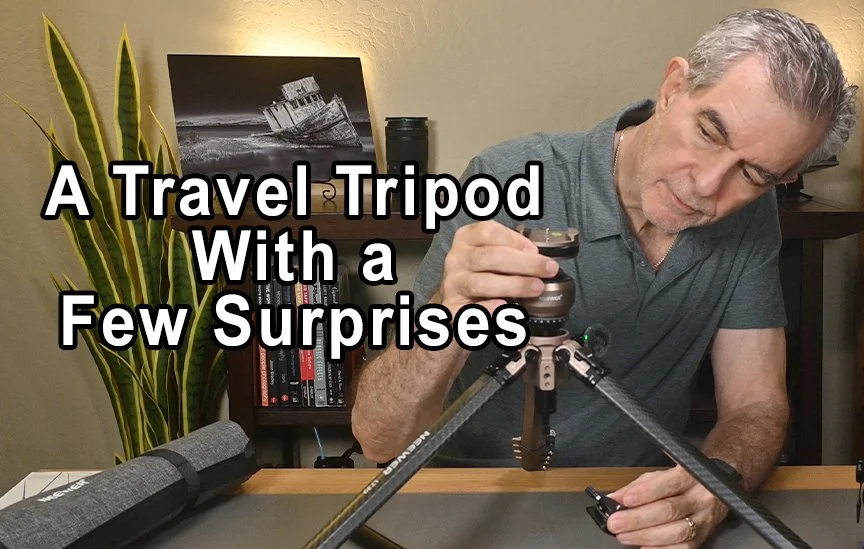
When I think about a travel tripod, there are usually three things I want to see: reasonable weight, compact size, and enough versatility that I’m not constantly wishing I had brought a larger tripod. The problem is that travel tripods often require compromises. Make them small enough and they can become too short. Make them lightweight enough and they may not feel particularly substantial. Add more features and suddenly they aren’t very compact anymore. That’s what makes the NEEWER LT39 carbon fiber travel tripod such an interesting option. It manages to combine a relatively light 2.7-pound weight and 19.3-inch folded length with a working height of up to 62.4 inches and a claimed load capacity of 22 pounds. But the specifications are only part of the story. What really makes the LT39 interesting is the way NEEWER has designed the tripod to give photographers several different ways to position the camera.
A Travel Tripod That Doesn’t Feel Like a Compromise
The first impression of the LT39 is that this doesn’t feel like an ultra-light tripod that has been stripped down to the bare minimum just to make it easier to carry. The four-section carbon fiber legs have a substantial feel to them, and the metal buckle-style leg locks make changing the height quick and straightforward. The carbon fiber construction helps keep the weight down while still providing the rigidity you’d expect from a serious photographic tripod.
At 2.7 pounds, the LT39 isn’t going to disappear into your camera bag, but it is light enough that carrying it on a photo walk, hike, road trip, or vacation shouldn’t become a burden. And that’s an important distinction. A tripod doesn’t do you much good if it’s sitting at home because you decided it was too heavy to bring along.
When folded, the LT39 measures approximately 19.3 inches long, with a folded diameter of about 2.2 inches. It’s not the smallest travel tripod available, but that additional size comes with a useful benefit: you’re getting a tripod that can reach a very respectable maximum height without requiring an extremely tall center column or a complicated setup.
Four-Section Carbon Fiber Legs
The tripod uses four-section carbon fiber legs, and the leg construction is one of the areas where the LT39 feels particularly well thought out. The sections fit tightly together, and the overall design makes it easy to grab the tripod with one hand and move it around.
Instead of traditional twist locks, NEEWER uses metal buckle-style locks. I like this type of system because it’s quick and visual. You can immediately see which sections are locked and which ones are released, and adjusting the tripod doesn’t require you to twist individual sections.
The legs can also be positioned at three different angles: 22, 55, and 85 degrees. The standard 22-degree position is what you’ll use for normal-height shooting, while the wider positions allow the tripod to progressively get closer to the ground.
That becomes particularly valuable for landscape photography. We often think about tripod height in terms of getting the camera higher, but lowering the camera can be just as important. A camera positioned closer to the ground can dramatically change the relationship between the foreground, middle ground, and background.
For macro photography, flowers, rocks, textures, and other low-level subjects, having those additional leg positions gives you considerably more freedom.
The Interchangeable Center Columns Are a Big Advantage
One of my favorite features of the LT39 is the center-column system.
NEEWER includes both a standard-length center column and a shorter center column. The standard column gives you the tripod’s full height range, allowing the camera to reach approximately 62.4 inches.
But when you want to get low, you can remove the standard column and install the shorter one.
This is a much better solution than simply extending and collapsing a long center column when you’re trying to work close to the ground. The short column allows the tripod legs to spread out while keeping the camera much closer to the ground.
And NEEWER takes the flexibility one step further because both columns can be installed upside down. This allows the camera to hang underneath the tripod.
For macro photographers, this can be particularly useful. Instead of being restricted to the camera positions available above the tripod, you can bring the camera down underneath the center of the tripod and work from a very low perspective.
It’s also useful for creative low-angle landscape compositions where you want the camera only inches above the ground.
A Low-Profile Ball Head
The LT39 comes with a detachable low-profile ball head, and I think this is another smart design choice.
A low-profile ball head keeps the camera closer to the tripod’s main support structure. That can make the overall setup feel more compact and help keep the center of gravity lower than a tall conventional head.
The head provides 360-degree panoramic movement and 90 degrees of tilt, giving you plenty of flexibility for both horizontal and vertical compositions.
And because the head is detachable, you’re not necessarily committed to using it forever. If you eventually decide that you prefer another head, the tripod’s detachable design gives you the option to change it.
That’s an important consideration for photographers who already have favorite tripod heads or who are gradually building a more customized support system.
Panoramas and the Quick-Release Plate
The included panoramic quick-release plate adds another interesting capability.
The camera attaches to the plate using a standard 1/4”-20 mounting screw, and the plate then locks into the ball head’s quick-release clamp.
Once the camera is mounted, the head provides 360-degree panoramic rotation.
For someone who enjoys making panoramic photographs, having that capability built into the head is certainly convenient.
There is one compatibility detail worth paying attention to, however. NEEWER specifies compatibility with PD V3 backpack clip plates and the included Arca-type plates. If you already have a collection of quick-release plates, L-brackets, or other accessories, it’s worth checking compatibility before assuming everything will work with the LT39.
That’s one of those little details that can become important once you start incorporating a new tripod into an existing camera system.
A Tripod Designed for Low-Angle Photography
One of the things that stands out to me about the LT39 is how much attention NEEWER has given to low-angle photography.
You have the three leg-angle positions.
You have the short center column.
And you can reverse the center column to position the camera underneath the tripod.
That gives you several different ways to get the camera down low.
And for landscape photography, that’s more important than it may initially sound.
Changing the camera height changes the composition. A camera positioned at eye level creates a very different photograph from one positioned two feet above the ground. Move it down to a foot or less and suddenly foreground elements can become much more prominent.
For macro photography, the benefit is even more obvious. Flowers, plants, rocks, mushrooms, insects, and other small subjects often look completely different when photographed from their level rather than from above.
The LT39 gives you the flexibility to explore those perspectives without needing to carry an additional specialized tripod.
A Useful Ballast Hook
The long center column also includes a hook at the bottom.
If you’re working in windy conditions or simply want additional stability, you can use the hook to suspend weight from the tripod.
A camera bag can work well for this, provided you use some common sense and don’t allow the bag to swing around in the wind.
It’s also worth remembering that adding weight doesn’t magically turn a lightweight travel tripod into a massive studio tripod. The best stability still comes from choosing a solid surface, spreading the legs properly, keeping the center column as low as practical, and positioning your camera and lens thoughtfully.
Still, having a ballast hook available is a nice feature when conditions become less than ideal.
Accessory Mounting Points Add Versatility
Another nice touch is the inclusion of 1/4”-20 accessory mounting points.
For photographers who also shoot video, this opens up some interesting possibilities. Depending on the accessories you’re using, you could mount things such as a small monitor, microphone, light, articulating arm, or other equipment.
NEEWER also includes a phone holder, which means the tripod can be used with a smartphone right out of the box.
That might not be the most important feature for a dedicated landscape photographer, but it does add versatility—and for photographers who create content, it’s another useful option.
What You Get in the Box
NEEWER provides a fairly complete package with the LT39.
Inside the package you’ll find the carbon fiber tripod with the low-profile ball head, the short center column, panoramic quick-release plate, phone holder, two L-shaped hex keys, and a carrying bag.
The tripod also comes with a limited two-year manufacturer’s warranty.
Having the short center column included is particularly nice because it isn’t an accessory you’ll have to purchase separately just to take advantage of the tripod’s low-angle capabilities.
Is the LT39 Really a Travel Tripod?
This is an interesting question because “travel tripod” can mean very different things to different photographers.
If your definition is the absolute smallest tripod that can fit into the smallest possible backpack, there are certainly more compact options.
But if your definition is a tripod that’s compact enough to travel with while still providing useful working height and serious photographic versatility, the LT39 makes a lot of sense.
At 19.3 inches folded, it isn’t tiny. But it gives you a maximum height of 62.4 inches, and that is a very useful combination.
For me, that’s the more important measurement.
There’s not much point in having an incredibly small tripod if I constantly have to bend over because it doesn’t get high enough.
The LT39 strikes a reasonable balance between portability and usability.
Things to Consider Before Buying
As with any piece of photographic equipment, there are a few things worth considering before making a purchase.
First, think about the folded length. At 19.3 inches, the LT39 is compact enough for many travel situations, but it may not fit into every camera backpack’s tripod compartment.
Second, consider the quick-release plate system. If you’re already invested in a particular plate or L-bracket ecosystem, make sure the compatibility works for your setup.
And finally, keep the 22-pound load rating in perspective. A manufacturer’s load rating is useful for comparing products, but maximum load capacity isn’t the same thing as maximum stability under every shooting condition. A long telephoto lens extended high above the tripod, for example, creates very different demands than a lightweight camera and wide-angle lens positioned close to the ground.
For landscape photography, I would still use the normal precautions: spread the legs properly, keep the center column as low as possible when conditions are challenging, and consider hanging some weight from the hook when appropriate.
My Overall Impression
What I like about the NEEWER LT39 is that it doesn’t seem to be designed around a single specification.
It isn’t simply trying to be the lightest tripod.
It isn’t trying to be the smallest.
And it isn’t simply trying to provide the highest load capacity.
Instead, NEEWER has combined a number of useful features into one relatively compact package.
The carbon fiber construction keeps the weight down. The four-section legs provide a useful height range. The metal buckles make setup quick. The three leg angles provide flexibility. The interchangeable center columns dramatically expand the low-angle possibilities. And the detachable low-profile ball head gives the tripod even more versatility.
That’s what makes the LT39 interesting to me.
A good tripod should give you more photographic possibilities, not simply provide a place to attach your camera.
And in that respect, the LT39 has a lot going for it.
For the landscape photographer, traveler, macro photographer, or content creator looking for a reasonably lightweight tripod that can handle a wide variety of shooting situations, the NEEWER LT39 carbon fiber travel tripod is definitely worth a closer look.
Because ultimately, the best tripod isn’t necessarily the biggest, lightest, or most expensive tripod you can buy.
It’s the tripod you’re actually willing to take with you.
And the LT39 looks like a tripod that could earn a permanent place in the travel bag.