The Best ND Filter for Landscape Photographers
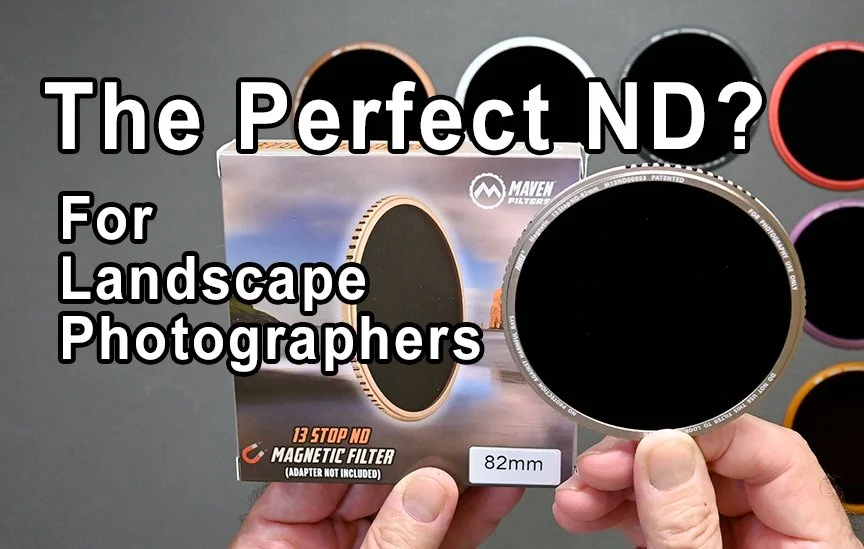
Why I Believe a 13-Stop ND Filter Is the Perfect Choice for Long Exposure Landscape Photography
For years, the 10-stop neutral density filter has been the undisputed king of long exposure landscape photography. It has earned a permanent place in countless camera bags because it allows photographers to transform rushing waterfalls into silky ribbons of water, soften crashing waves into smooth mist, and stretch moving clouds into dramatic streaks across the sky. If you asked photographers which ND filter they should own, the answer was almost always the same: buy a quality 10-stop filter.
Lately, however, I’ve found myself reaching for something different.
A dedicated 13-stop neutral density filter has become one of my favorite tools for creating long exposure landscape images, and after spending time working with it, I believe it occupies what many photographers would call the “sweet spot.” It provides enough light reduction to produce beautiful multi-minute exposures in a wide variety of lighting conditions without becoming so dark that composing, focusing, and calculating exposures becomes an unnecessary challenge.
Before diving into why I believe the 13-stop filter deserves a place in every landscape photographer’s kit, I want to mention one thing. Normally, I would include side-by-side comparison photographs taken with 10-stop, 13-stop, 15-stop, and even 18-stop filters. Unfortunately, I’m writing this during the middle of an Arizona summer, when daytime temperatures routinely exceed 115 degrees. Those conditions simply aren’t ideal for spending hours outdoors creating meaningful comparison images.
As the temperatures cool this fall, I plan to photograph identical scenes using each of these filters so everyone can see the differences under real-world conditions. Until then, I thought it would be worthwhile to explain why I believe the 13-stop ND filter has earned a permanent place in my camera bag.
From Screw-In Filters to Magnetic Systems
Landscape photographers who have been around for a while probably remember the classic neutral density filter kit. Most photographers carried three filters: a 3-stop, a 6-stop, and a 10-stop. Between those three filters, nearly every lighting situation could be handled. When additional density was needed, the solution was simple—stack filters together.
The process worked, but it wasn’t particularly enjoyable.
Screw-in filters had an annoying tendency to bind together, making them difficult to remove both from each other and from the lens. Cross-threading was always a possibility, especially when changing filters quickly during sunrise or sunset. It was simply accepted as part of the workflow.
Today’s magnetic filter systems have changed that experience completely. Instead of carefully threading filters together, photographers can simply snap one filter onto another in seconds. Need 13 stops? Attach a 3-stop filter to your 10-stop filter and you’re ready to shoot.
The convenience is undeniable.
But convenience alone doesn’t necessarily make it the best solution.
Why I Prefer a Dedicated 13-Stop Filter
Although magnetic systems make stacking incredibly easy, I still believe that whenever possible it’s better to use the correct filter for the job rather than combining multiple filters to achieve the desired density.
A dedicated 13-stop filter provides a cleaner optical path. Instead of light passing through multiple filters, it travels through a single piece of optical glass. Fewer glass surfaces mean fewer opportunities for internal reflections, flare, ghosting, and a subtle loss of contrast.
There are practical advantages as well.
Using a single filter reduces the chances of vignetting, particularly when working with ultra-wide-angle lenses. It also means one less filter to clean, fewer fingerprints to remove, less dust to worry about, and one less component to manage while the light is changing rapidly.
Until recently, I stacked a 10-stop and a 3-stop filter whenever I wanted approximately 13 stops of density. I’ll still do that whenever the situation calls for it. In fact, that’s one of the biggest advantages of today’s magnetic filter systems.
However, when I know I’m heading into the field specifically to create multi-minute long exposures, I’d much rather carry a dedicated 13-stop filter. It’s faster, cleaner, and removes one more distraction so I can focus entirely on creating the photograph.
Comparing the Different ND Filter Strengths
Understanding why the 13-stop filter has become my favorite requires looking at how each of the darker neutral density filters performs in the field.
The 10-stop ND filter has long been considered the standard for landscape photography. It excels during sunrise and sunset, overcast conditions, waterfalls, streams, and situations where moderate cloud movement is desired. Under many conditions it produces exposures measured in seconds or even a few minutes.
The limitation appears on bright sunny days. While a 10-stop filter still produces beautiful results, exposure times often fall into the eight- to twenty-second range instead of the two- to five-minute exposures that many photographers are looking for.
Adding just three more stops may not sound significant, but every stop of light doubles the exposure time. As a result, a 13-stop filter allows shutter speeds that are eight times longer than a 10-stop filter.
For example, an exposure of eight seconds with a 10-stop filter suddenly becomes approximately one minute with a 13-stop filter. Sixteen seconds becomes roughly two minutes. Thirty-two seconds stretches to four minutes, and a one-minute exposure extends to approximately eight minutes.
Those additional three stops dramatically expand your creative possibilities.
Suddenly you’re producing the silky water, dramatic cloud streaks, disappearing crowds, empty city streets, and dreamlike landscapes that have made long exposure photography so popular. Better still, these results can often be achieved in bright daylight without needing to stop your lens down to extremely small apertures like f/22.
Move beyond 13 stops, however, and the advantages begin to diminish for many photographers.
A 15-stop filter is an outstanding choice when working in bright midday sunlight or when intentionally creating exposures lasting five to fifteen minutes. The tradeoff is that composing and focusing become increasingly difficult, exposure calculations become more critical, and cloud movement can become so blurred that much of its natural texture disappears.
An 18-stop filter is even more specialized. These filters are designed for photographers pursuing exposures lasting ten, twenty, or even thirty minutes. They excel in architectural photography, removing moving people from scenes, and creating minimalist fine art images. For everyday landscape photography, however, they often introduce more challenges than benefits. Autofocus becomes impractical, composition grows increasingly difficult, wind can easily introduce vibration during lengthy exposures, and hot pixels become more noticeable as sensor temperatures rise.
Why 13 Stops Feels Like the “Goldilocks” Filter
The reason so many photographers are embracing the 13-stop filter is simple—it strikes an ideal balance.
It consistently delivers exposure times in the two- to five-minute range under a wide variety of daylight conditions. Those longer exposures beautifully smooth moving water, create dramatic cloud movement without eliminating all texture, and remain practical to compose and focus with in the field.
Rather than being too little or too much, 13 stops often feels just right.
Why Not Simply Stack a 10-Stop and a 3-Stop Filter?
This is probably the most common question photographers ask.
Mathematically, stacking a 10-stop filter with a 3-stop filter produces the same 13-stop light reduction. There’s absolutely nothing wrong with doing that, and it’s a technique many photographers—including myself—have relied on for years.
The difference lies in optical efficiency and workflow.
Every additional filter introduces more glass surfaces that light must pass through. Even with premium multi-coated filters, those extra surfaces slightly increase the chances of flare, reflections, ghosting, and reduced contrast.
Stacking also increases the distance between the filter and the front of the lens, making vignetting more likely on ultra-wide-angle lenses.
A dedicated 13-stop filter simplifies everything. It’s faster to install, easier to keep clean, less prone to optical issues, and eliminates another potential point of failure.
If you already own both a 10-stop and a 3-stop filter, continue stacking them when necessary. Modern magnetic filter systems make that process remarkably quick and convenient.
However, if long exposure photography is something you regularly pursue, investing in a dedicated 13-stop filter makes a great deal of sense.
One Filter, Multiple Cameras
At the time of writing, Maven’s 13-stop neutral density filter is available in 72mm and 82mm sizes.
If your primary landscape lens uses one of those filter diameters, you’re ready to go.
If your camera, secondary lenses, or smartphone require smaller filter sizes, additional sizes are expected in the future. Until then, my recommendation is simple: purchase the filter that fits your primary landscape lens and use Maven’s threadless magnetic step-up rings to adapt it to your smaller lenses or smartphone filter adapter.
It’s a practical solution that allows one premium filter to serve multiple cameras, multiple lenses, and even your phone without purchasing duplicates in several different sizes.
Final Thoughts
Photography is filled with equipment choices, and there’s rarely one perfect solution for every photographer. The traditional 10-stop ND filter continues to deserve its reputation, and there are certainly situations where a 15-stop or even an 18-stop filter is the right tool.
But if your goal is to create dramatic long exposure landscapes with silky water, sweeping cloud movement, and exposure times measured in minutes instead of seconds, I believe the 13-stop neutral density filter deserves serious consideration.
It isn’t simply another filter density. It’s a purpose-built tool that consistently delivers the shutter speeds many landscape photographers are trying to achieve while keeping the shooting experience practical, efficient, and enjoyable.
Sometimes the best piece of gear isn’t the one with the biggest specifications or the newest technology. It’s the one that quietly earns a permanent place in your camera bag because it helps you create the photographs you envisioned. For me, that’s exactly what the 13-stop ND filter has become.