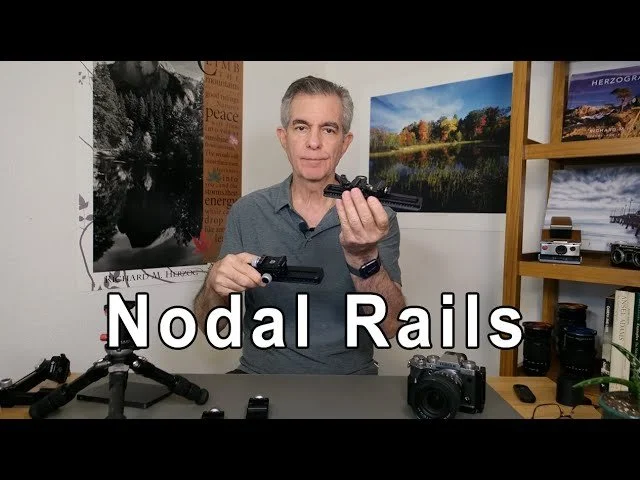
Really Right Stuff vs. Acratech Nodal Rails: Choosing the Best Panorama Rail for Landscape Photography
There is something incredibly rewarding about creating a sweeping panoramic photograph. A single image can capture an expansive mountain range, an endless desert landscape, or an entire coastline in a way that simply isn’t possible with a standard photograph. Yet anyone who has attempted panoramic photography has probably experienced the frustration of images that refuse to stitch together properly. Crooked horizons, ghosting, mismatched foregrounds, and alignment errors can quickly turn what should have been a spectacular panorama into a disappointing editing session.
While software has become remarkably good at stitching multiple photographs together, it can only work with the images it is given. The secret to creating flawless panoramas begins long before you open Lightroom or Photoshop. It starts in the field with proper camera placement, and one of the most important tools for achieving that precision is a quality nodal rail.
For landscape photographers who enjoy creating panoramic images, a nodal rail is one of those accessories that often gets overlooked until you actually use one. Once you understand what it does and how much easier it makes panoramic photography, it quickly becomes an essential part of your camera bag. In my own photography, I rarely leave home without one.
What Is a Nodal Rail?
A nodal rail is a precision-machined rail that allows you to slide your camera forward and backward while keeping it securely mounted on your tripod. Although it looks like a simple piece of aluminum, its purpose is incredibly important.
When photographing a panorama, the camera should rotate around the lens’s entrance pupil—commonly referred to by photographers as the “nodal point.” Rotating around this point minimizes parallax, the visual shift that occurs when foreground and background objects appear to move relative to each other as the camera rotates.
Parallax is one of the biggest reasons panoramic images fail to stitch correctly. When the camera rotates from the tripod socket instead of the lens’s entrance pupil, nearby objects shift against distant objects between frames. Stitching software then struggles to determine how those images fit together, resulting in visible seams, distorted objects, or failed panoramas.
A nodal rail solves this problem by allowing you to position your camera so that it rotates from the correct point on the lens instead of from the camera body.
Why Precision Matters
Not all nodal rails are created equally. Since they become the foundation of your panoramic setup, you want a rail that is both incredibly rigid and extremely precise.
Even a tiny amount of movement can introduce inconsistencies between frames. Flexing, slipping, or poor machining may not seem significant while you’re standing behind the camera, but those small movements become very noticeable once you begin stitching several high-resolution images together.
This is why many serious landscape photographers invest in premium rails rather than inexpensive alternatives. A well-built rail provides confidence that every adjustment is repeatable and every lockup remains solid throughout the entire panoramic sequence.
Really Right Stuff NPR-192 with Mini Clamp Package
One of the standout options discussed in this comparison is the Really Right Stuff NPR-192 with the Mini Clamp package.
Really Right Stuff has built its reputation by producing some of the finest camera support equipment available. Their products are manufactured to extremely tight tolerances and are designed to withstand years of heavy professional use.
The NPR-192 offers generous adjustment length, making it suitable for a wide variety of camera and lens combinations. The included Mini Clamp securely locks the camera in place while still allowing quick adjustments when changing lenses or camera bodies.
One of the features photographers immediately notice is the smooth movement along the rail. Adjustments are easy to make, yet once tightened, everything locks down firmly with virtually no movement. This level of precision becomes especially valuable when photographing multiple-row panoramas or high-resolution stitched landscapes where every frame needs to align perfectly.
The engraved measurement markings also make it easy to record your preferred settings for different lenses. Once you’ve found the ideal nodal position for a particular lens, you can quickly return to that exact position every time you shoot.
Really Right Stuff MPR-CL Rail with Integral Clamp
Another excellent option from Really Right Stuff is the MPR-CL rail with its integral clamp.
Instead of using a separate clamp, this model incorporates the clamp directly into the rail itself. The integrated design simplifies the setup while reducing the number of components required in the field.
For photographers who value simplicity and efficiency, this integrated approach can be very appealing. It minimizes setup time and provides a clean, streamlined solution that still offers the same precision and rugged construction that Really Right Stuff is known for.
Like the NPR-192, the MPR-CL features beautifully machined aluminum construction, engraved scales, and exceptional rigidity. Every adjustment feels deliberate and secure, inspiring confidence when shooting demanding panoramic sequences in challenging outdoor conditions.
Acratech Nodal Rail Version 2
The Acratech Nodal Rail Version 2 provides another outstanding solution for panoramic photography and offers several design features that make it unique.
Acratech has long been recognized for producing innovative tripod heads and panoramic accessories that combine strength with remarkably lightweight construction. Their products are especially popular among landscape photographers who regularly hike long distances and want to minimize pack weight without sacrificing performance.
The Version 2 nodal rail continues that philosophy by offering excellent rigidity while maintaining a relatively lightweight design. The machining quality is outstanding, and the open-frame construction helps reduce weight while still providing exceptional stability.
Like the Really Right Stuff rails, the Acratech allows precise fore-and-aft adjustments for locating the entrance pupil of your lens. Once positioned correctly, the locking mechanism holds everything securely in place throughout the panoramic sequence.
Its compact design also makes it an attractive option for photographers who want a capable nodal rail that occupies minimal space inside their camera bag.
Finding the Correct Nodal Point
Owning a quality nodal rail is only part of the equation. To take full advantage of it, you’ll need to determine the correct entrance pupil location for each lens you use.
The process is relatively straightforward. Place one object close to your camera and another farther away so they overlap in your viewfinder. Rotate the camera left and right while adjusting the camera position along the rail. When the foreground object no longer shifts against the background object during rotation, you’ve found the correct position.
Once you’ve identified that location, simply note the measurement engraved on the rail. The next time you use that lens, you can immediately return to the same setting without repeating the entire process.
Many photographers create a small reference card listing the ideal rail position for each of their lenses, making field setup fast and effortless.
Better Panoramas Begin in the Field
Many photographers assume panorama stitching is primarily a software task, but experienced landscape photographers know that success begins with careful field technique.
Proper leveling, consistent exposure, manual white balance, accurate overlap between frames, and eliminating parallax all contribute to cleaner stitches and better final image quality. A quality nodal rail helps remove one of the biggest variables by ensuring the camera rotates from the proper position every single time.
The result is panoramas that require less correction during editing, stitch together more naturally, and retain maximum sharpness across the entire image.
Choosing the Right Rail
Whether you choose the Really Right Stuff NPR-192 with the Mini Clamp package, the Really Right Stuff MPR-CL with its integral clamp, or the Acratech Version 2, each represents a premium solution capable of producing professional-quality panoramic images.
Your decision ultimately comes down to your preferred workflow, desired features, and budget. Some photographers appreciate the modular flexibility of the NPR-192, while others prefer the streamlined simplicity of the MPR-CL. The Acratech Version 2 offers an excellent balance of lightweight design, rugged construction, and precision engineering that many outdoor photographers find especially appealing.
Whichever model you choose, investing in a quality nodal rail is an investment in better panoramas. Instead of fighting stitching errors in post-processing, you’ll spend more time creating expansive, high-resolution landscape images that come together effortlessly.
For photographers who are serious about panoramic landscape photography, a nodal rail isn’t just another accessory—it’s one of the most valuable tools you can add to your tripod system. When paired with careful technique and a solid tripod, it becomes the foundation for creating seamless panoramic photographs that fully capture the grandeur of the landscapes you set out to photograph.