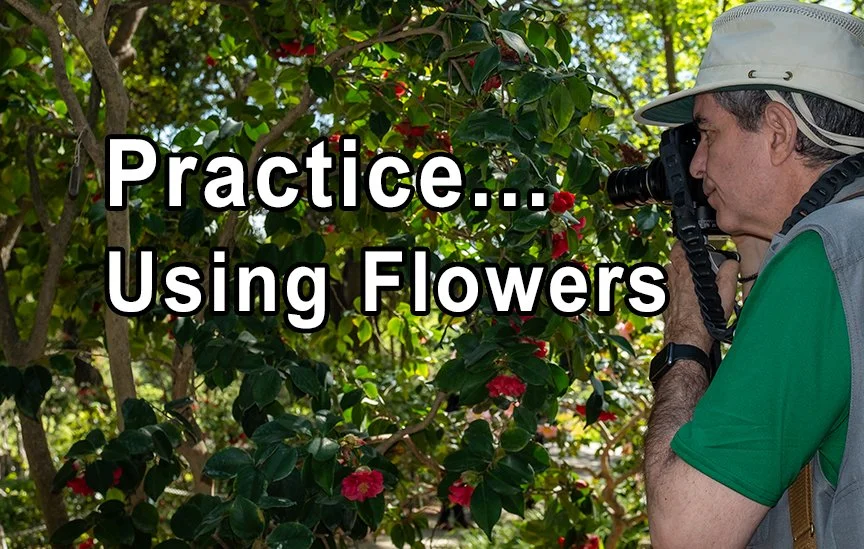
If you’ve spent any time exploring my website, you may have noticed something that surprises a lot of visitors. Alongside galleries filled with sweeping mountain vistas, dramatic desert sunsets, colorful forests, waterfalls, and other landscapes, you’ll also find a collection of flower photographs. It’s a question I’ve been asked more than once: “Richard, I thought you were a landscape photographer. Why are there flowers on your website?” At first glance, it might seem like an odd combination. After all, landscapes and flowers appear to be two very different genres of photography. One captures expansive scenes that stretch for miles, while the other focuses on subjects small enough to fit in the palm of your hand. Yet despite their obvious differences, they share something incredibly important. For me, photographing flowers isn’t a departure from landscape photography—it’s one of the best ways to become a better landscape photographer.
The reason is surprisingly simple: practice, practice, practice. Every photographer wants to improve, but improvement doesn’t happen only during trips to national parks or weekends spent chasing dramatic sunrises. It happens every time you pick up your camera. Photography is a skill that develops through repetition, observation, and experience. The more frequently you practice, the more naturally composition, exposure, and camera operation become second nature. Waiting weeks between landscape outings means waiting weeks between opportunities to improve. Flower photography fills that gap, allowing you to sharpen the exact same skills without traveling hundreds of miles to find an epic view.
Landscapes Aren’t Available Every Day
Let’s face it—most of us can’t photograph spectacular landscapes whenever we feel like it. Life has a way of getting in the way. We have jobs, family responsibilities, appointments, errands, and countless other commitments that compete for our time. Even when our schedules allow us to head out with a camera, the weather may not cooperate. The light may be flat, storms may roll in unexpectedly, or the location you’ve been planning to visit may simply be too far away for a quick afternoon trip.
Many of my favorite landscape locations require hours of driving before I even unpack my camera. Add in hiking, scouting compositions, and waiting for the perfect light, and photographing landscapes often becomes an all-day adventure. While those experiences are incredibly rewarding, they aren’t something most photographers can do every weekend. If we only practice when we’re standing in front of a spectacular mountain range or dramatic coastline, our growth as photographers slows considerably.
Instead of waiting for the next big adventure, I believe it’s far more productive to continue photographing wherever you happen to be. The camera doesn’t care whether you’re standing in Yosemite National Park or walking through your backyard. Every time you compose an image, evaluate the light, or adjust your camera settings, you’re building skills that will serve you the next time you find yourself in front of an unforgettable landscape.
Flowers Teach the Same Skills as Landscapes
Some photographers think flower photography and landscape photography require completely different ways of seeing, but I couldn’t disagree more. The subject changes, but the creative process remains remarkably similar. Every flower presents an opportunity to make the same compositional decisions that define successful landscape photography.
Whenever I’m photographing flowers, I’m constantly evaluating the scene. I’m deciding where to place my subject within the frame, studying how the light shapes the petals, and determining whether the background supports or distracts from the composition. I ask myself if moving a few inches to one side would create a cleaner image, whether a different focal length would simplify the scene, or if changing my camera height would strengthen the photograph. These are the exact same questions I ask when photographing mountains, lakes, waterfalls, deserts, or forests.
Flower photography also reinforces many of the fundamental principles that every landscape photographer relies upon. Composition, balance, color harmony, depth of field, leading lines, visual weight, simplicity, and the relationship between foreground and background all play an important role. The techniques don’t suddenly change because the subject is smaller. In fact, flowers often make these lessons easier to understand because they allow you to isolate individual elements without the complexity of an enormous landscape.
Learning to Truly See
One of the greatest benefits of photographing flowers is that they teach you to slow down. In today’s world, it’s easy to rush from one composition to the next, hoping that a beautiful location alone will produce a great photograph. Flower photography encourages the opposite approach. Instead of taking in an entire scene at once, you begin paying attention to the smallest details.
You notice how early morning light gently wraps around delicate petals. You become aware of tiny shadows that reveal texture and depth. You recognize distracting highlights in the background that compete with your subject. You begin asking yourself whether lowering your tripod by just a few inches creates a cleaner composition or whether rotating your camera slightly improves the balance of the frame. These subtle observations train your eye to become more intentional, and that awareness carries directly into your landscape photography.
Over time, you stop simply looking at a scene and begin truly seeing it. That’s one of the biggest differences between taking snapshots and creating photographs. Great photographers develop the ability to recognize relationships between light, shape, color, texture, and composition almost instinctively. That ability isn’t something you’re born with. It’s developed through practice, and flowers provide an outstanding opportunity to build that skill close to home.
Master Your Equipment Before the Big Trip
Flower photography is also an excellent way to become completely comfortable with your camera and lenses. Unlike a dramatic sunrise that may last only a few minutes, flowers aren’t going anywhere. They give you the freedom to experiment without feeling rushed. If one approach doesn’t work, you can try another. If you make a mistake, you simply adjust your settings and continue learning.
This is the perfect environment for experimenting with different apertures to understand depth of field, practicing focus stacking for maximum sharpness, refining your manual focus technique, testing exposure compensation, or comparing how different focal lengths influence perspective. It’s also an ideal opportunity to become more proficient with filters, tripod positioning, and camera controls. The more comfortable you become operating your equipment during these practice sessions, the more confident you’ll feel when photographing a once-in-a-lifetime landscape.
When you’re standing in front of an incredible sunrise, the last thing you want to be doing is searching through menus or wondering which camera setting to use. You want your equipment to feel like an extension of your creativity. That confidence doesn’t come from reading camera manuals. It comes from spending time behind the camera and building experience through repetition.
Your Backyard Can Become Your Best Classroom
One of the biggest misconceptions in photography is that you need extraordinary locations to become an extraordinary photographer. While iconic destinations certainly provide beautiful subjects, they aren’t the only places where meaningful learning takes place. Some of the most valuable practice sessions happen just a few steps outside your own home.
Your backyard can become a classroom filled with opportunities to improve. Your neighborhood park can teach you about changing light, composition, and seasonal color. Even a small flower bed along a sidewalk can challenge you to find interesting perspectives and simplify a busy scene. Every outing, no matter how close to home, strengthens your ability to recognize good light, compose stronger images, and operate your camera with confidence.
Perhaps the greatest advantage of photographing close to home is that there’s no pressure. You’re free to experiment, make mistakes, and revisit the same subjects as often as you’d like. Each visit becomes another opportunity to refine your skills, and every lesson learned carries over into your next landscape adventure.
Photography Is About Learning to See
People often ask me what piece of equipment has had the biggest impact on my photography. They’re usually expecting me to mention a camera body, a lens, or a favorite tripod. My answer is almost always the same. The most important improvement hasn’t come from buying better gear. It’s come from training myself to see.
Photography isn’t simply about recording what’s in front of you. It’s about recognizing beautiful light before it disappears. It’s about understanding composition well enough to remove distractions before pressing the shutter. It’s about anticipating how the eye will move through an image and creating photographs that communicate a feeling rather than simply documenting a place.
The more you practice, the more instinctive these skills become. You begin recognizing strong compositions almost immediately. Camera settings become second nature. Instead of thinking about buttons and menus, you’re free to concentrate on creativity, storytelling, and capturing the experience of being there. That’s the point every photographer hopes to reach, and consistent practice is the path that gets you there.
Every Photograph Prepares You for the Next One
The next time you can’t make it to your favorite landscape location, don’t leave your camera sitting on the shelf. Step outside. Walk through your neighborhood. Visit a nearby park. Find a flower, slow down, and spend time exploring everything it has to teach you. Experiment with different compositions, change your perspective, test new techniques, and challenge yourself to create the strongest photograph you can from an ordinary subject.
You may discover that some of your greatest improvements as a landscape photographer happen when there isn’t a mountain, waterfall, or dramatic sunset anywhere in sight. Every photograph you make strengthens your eye, reinforces your technical skills, and prepares you for the next unforgettable landscape you’ll eventually photograph.
That’s why you’ll continue to find flower photographs throughout my website. They aren’t there because I’ve stopped loving landscapes. They’re there because photographing flowers has helped me become a better landscape photographer. And if you’re looking for a simple, enjoyable way to improve your own photography, I believe they can do the same for you.